!A small balcony coop featuring apartment friendly urban chicken breeds with a city view.
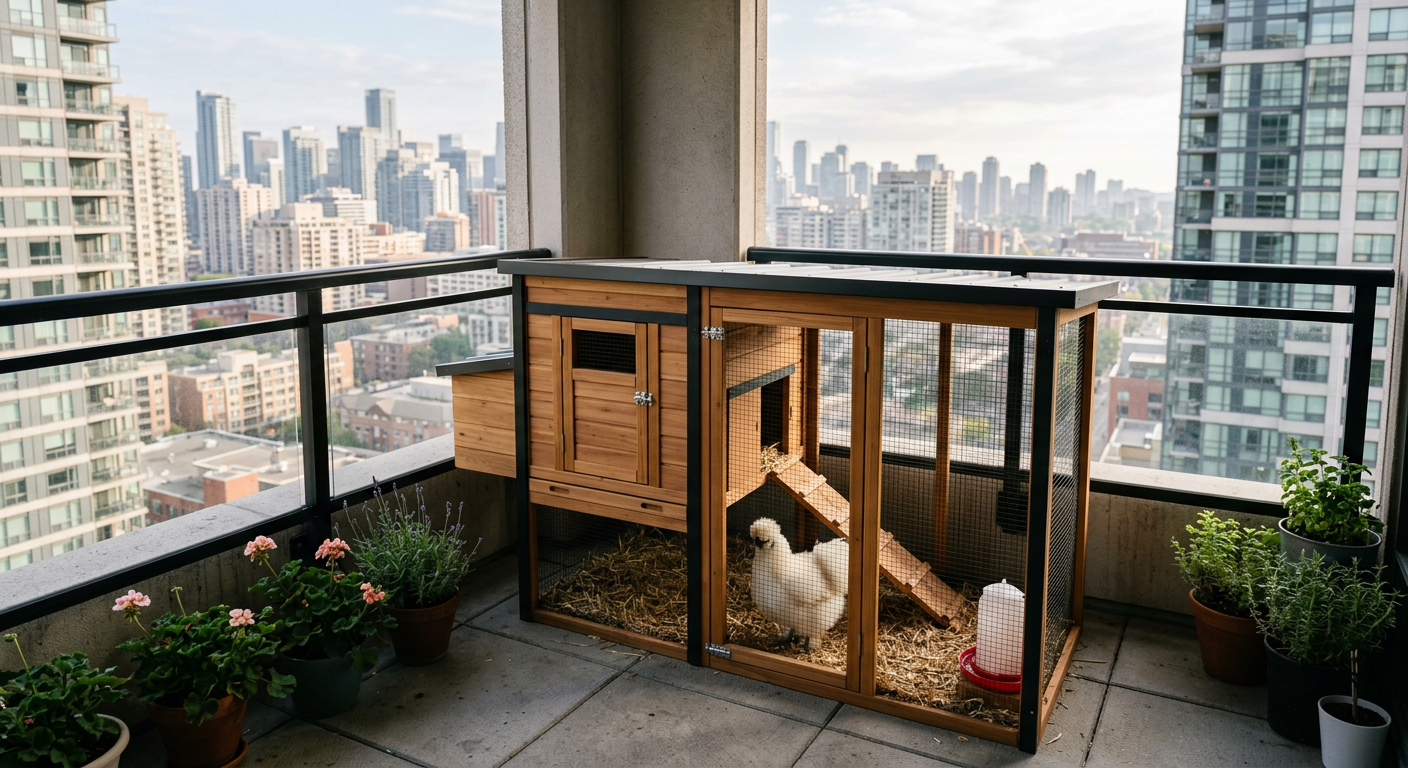
I’ll never forget the first time I saw it. We were visiting my sister in the city, walking down a street lined with brick walk-ups, and I glanced up. There, on a third-floor balcony, tucked between a satellite dish and a pot of sad-looking basil, was a tiny chicken coop with two fluffy white chickens pecking around. I just stopped and smiled—it was proof that the homesteading spirit can, and will, find a way to grow anywhere.
🎯 Quick Answer: The best apartment friendly urban chicken breeds are almost always Bantams. Breeds like Silkies, Bantam Cochins, and D’Uccles are your best bet due to their small size, quiet nature, and friendly temperament, making them ideal for close quarters and keeping neighbors happy.
🔑 Key Takeaways
* Size Matters Most: Bantams, which are miniature versions of standard chicken breeds, are the key to urban success.
* Quiet is King: A hen’s temperament and noise level are far more important than her egg size when you share walls with neighbors.
* Laws First, Birds Second: Before you buy a single chick, you MUST become an expert on your city, county, and even HOA’s rules on poultry.
* Small Space, Big Responsibility: A balcony coop still requires daily cleaning, fresh food and water, and security from urban predators like raccoons.
* Manage Egg Expectations: Bantam eggs are small. You’ll get a delicious, fresh breakfast, not a commercial egg operation.
* Neighbors are Your Flock, Too: A little friendliness (and a few gifted eggs) goes a long way to ensuring a peaceful-coexistence.
—
!Comparing egg sizes from apartment friendly urban chicken breeds on a wooden table.

What Does “Apartment Friendly” Even Mean?
Let’s be clear. We’re not talking about letting chickens run loose in your living room. When we say “apartment friendly,” we’re talking about keeping a very small flock (2-3 hens) in a secure coop on a sturdy balcony, patio, or a tiny yard space. The entire game is about minimizing impact.
Noise is Your #1 Enemy
Unlike on our ten acres where a loud hen is just part of the morning chorus, in the city, a noisy chicken is a potential eviction notice. Standard breeds like Leghorns or Rhode Island Reds can be LOUD when they lay an egg. They announce it to the world. A lot of the ideal apartment friendly urban chicken breeds are chosen specifically because they are genetically less prone to loud, consistent squawking.
I learned this the hard way through a friend. He lived in a duplex and got three beautiful standard-sized hens. Every single morning around 8 AM, one of them would let out an “egg song” that echoed through the shared wall. After two weeks of passive-aggressive notes, he had to re-home his birds. It was heartbreaking.
Temperament in Tight Quarters
When you only have 20 square feet, you can’t have a bully. Flighty, aggressive, or high-strung birds will be miserable and make you miserable. You need calm, docile birds that tolerate being handled and don’t mind a smaller world. This side of raising backyard chickens is often overlooked but it’s critical.
Thinking about the bigger picture is part of the process. Early on, we realized that successful homesteading is 90% planning. That’s why we put together tools on Homestead OS to help folks map out their goals before they ever buy a single animal or seed.
Now, let’s get to the fun part: picking your birds.
Keep reading — this is where we get into the specific breeds that won’t get you kicked out.
—
The Best Apartment Friendly Urban Chicken Breeds
After years of raising all sorts of birds and talking to countless other homesteaders, these are the breeds we see succeed time and time again in tight urban spaces.
H3: Silkies: The Fluffy Lap Chickens
If you want a chicken that acts more like a pet cat, get a Silkie. They are unbelievably fluffy (it’s actually more like fur than feathers), incredibly docile, and very, very quiet. We had a Silkie named Marshmallow who would happily sit in our daughter’s lap for ages. They are also notoriously broody, meaning they’ll try to hatch eggs (even unfertilized ones), which is adorable but means they stop laying.
* Noise Level: 1/10 (Very quiet, make soft cooing sounds)
* Space: Minimal. They don’t fly well.
* Eggs: 2-3 small, cream-colored eggs a week. Not great producers.
* Personality: Sweet, calm, and cuddly. The ultimate pet chicken.
H3: Bantam Cochins: The Feathered Beach Balls
These are my personal favorite for small-space applications. Bantam Cochins are round, fluffy balls of charm. They have feathers all the way down their legs and feet, which is just delightful. They are exceptionally calm and handle confinement better than almost any other breed. They are content in a smaller coop and run, provided it’s clean and safe.
* Noise Level: 2/10 (Generally quiet, soft clucks)
* Space: Excellent for small spaces.
* Eggs: 2-4 small, light brown eggs a week.
* Personality: Gentle giants in a tiny body. Great with kids.
H3: D’Uccles: The Bearded Belgians
Belgian d’Uccle Bantams (pronounced doo-clay) are another winner. They are tiny, even for bantams, and are best known for their funny little beards, muffs, and heavily feathered feet. They have a friendly and curious personality but can be a bit more active than a Cochin. Their small size makes them a perfect fit for a limited footprint.
* Noise Level: 3/10 (A little more chatty, but not loud)
* Space: Very minimal needs.
* Eggs: Around 2-3 tiny, cream-colored eggs weekly.
* Personality: Spunky, curious, and friendly. True characters.
H3: Sebrights: The Tiny Show-Offs
If aesthetics are your top priority, look at Sebrights. They don’t have feathered feet, but their patterns are stunning—each feather is outlined in a different color. They are true bantams, meaning there is no large-fowl version. While beautiful and tiny, they can be a bit more flighty and active than Silkies or Cochins, so ensure your balcony has a roof or netting!
* Noise Level: 4/10 (Can be a bit chattier than the others)
* Space: Minimal, but they appreciate a bit more room to forage.
* Eggs: About 1-2 tiny white eggs a week. Not kept for eggs.
* Personality: Active, alert, and incredibly beautiful. More for show than for snuggles.
Choosing the right breed is just step one. Now you have to build their tiny home.
—
The Reality Check: Coop, Smell, and Laws
This is the un-glamorous part that separates the successful urban chicken keepers from the ones who post “chickens for sale, must go ASAP” on Craigslist after a month.
H3: Tiny Coops for Tiny Spaces
You don’t need a huge barn. For 2-3 bantam hens, you can get away with a coop that has a 4-6 square foot footprint. Look at vertical designs that have the roosting area up top and a small, enclosed run underneath. We’ve used an Omlet Eglu Go for a quarantine coop before, and while pricey (around $500), its plastic design is incredibly easy to clean and perfect for a patio.
DIY is cheaper if you have the skills. Just make sure it is 100% predator-proof. Raccoons are clever and can open simple latches. We use carabiner clips on all our doors, even out here in the country. It’s a simple, $2 solution. You’ll find a list of must-have security items in our guide to essential homesteading tools to buy first.
H3: Managing Smell and Mess
Chicken poop stinks. There’s no way around it. The key to not bothering your neighbors (or yourself) is daily management. A quick scoop of the poop from under the roosting bars every morning takes 60 seconds. A full bedding change once a week (for a small coop) is non-negotiable. Using pine shavings or hemp bedding helps control moisture and odor.
H3: Decoding Your City’s Laws
I’m going to say this again because it’s the most important part: CHECK YOUR LOCAL LAWS. Google “[Your City Name] poultry ordinance.” Read it. Print it out. Read it again.
Look for:
* Is it legal to keep chickens at all?
* How many are you allowed? (Usually 3-6)
* Are roosters banned? (Almost always, YES.)
* Are there coop setback requirements (e.g., must be 10 feet from property line)?
Don’t rely on a blog post. Check a primary source, like your city’s website or a resource like this list of state poultry associations from the USDA. Getting this wrong is the costliest mistake you can make.
It’s not just about what birds you get; it’s about what you do with them.
—
!A colorful bantam hen, one of many apartment friendly urban chicken breeds, on a balcony.

What to Expect: Eggs, Costs, and Daily Chores
Let’s get down to the brass tacks of what this new hobby will actually look like in your daily life. It’s more than just cute, fluffy chickens.
H3: The Egg Question
Bantam eggs are tiny. It takes about two or three bantam eggs to equal one standard large egg from the grocery store. With two or three hens, you might get 4-6 small eggs a week. This is enough for a special weekend breakfast for one or two people.
The flavor is incredible—the yolks are rich and creamy. But you are not doing this to save money on eggs. This is about the joy and connection to your food. A journey we detail in our post about the pros and cons of raising backyard chickens.
H3: The Real Startup Costs
Starting small doesn’t mean starting for free. Here’s a realistic breakdown from when we helped a friend set up their balcony flock of three Silkies:
* 3 Silkie Chicks: $12 each = $36
* Small Pre-Fab Coop: $289
* Feeder & Waterer: $35
* First Bag of Chick Starter Feed: $22
* Pine Shavings Bedding: $10
Total startup cost: $392. This can be done cheaper if you build your own coop, but it’s a real number to plan for. Don’t forget the ongoing cost of feed. For more tips on starting smart, our guide on homesteading on a budget is a good place to start.
H3: The Daily Grind (Even on a Balcony)
This is a living creature that depends on you. Every single day, you’ll need to:
Once a week, you’ll need to do a full coop clean-out, which might take 20-30 minutes. It’s a commitment, but the reward of a fresh egg you helped create is worth it.
💡 Pro Tips
We learned these lessons the hard way so you don’t have to.
* Hens ONLY. I can’t stress this enough. Roosters are loud, illegal in most cities, and you do NOT need one for hens to lay eggs. If you buy straight-run chicks (unsexed), have a plan for what to do with any roosters.
* Start with Two, Not One. Chickens are flock animals and will be stressed and lonely if kept by themselves. Two is the perfect starting number for a tiny flock.
* Bribe Your Neighbors. The first time you get a few eggs, put them in a little carton and give them to your immediate neighbors. A small act of kindness can prevent a hundred noise complaints.
* Enrichment is Not Optional. A bored chicken is a destructive chicken. Hang a head of cabbage from a string (we call it “cabbage tetherball”) for them to peck at. Provide a small pan of dirt or sand for a dust bath. This is crucial for their health and happiness.
⚠️ Beginner Mistakes to Avoid
I’ve seen all of these happen. Please, read this section twice.
—
!Fresh eggs from apartment friendly urban chicken breeds in a bowl on an urban patio.

Frequently Asked Questions
H3: How many eggs do bantam chickens lay?
It varies by breed, but a good estimate is 2-4 eggs per week per hen. These eggs will be about half to two-thirds the size of a standard store-bought egg.
H3: Do apartment chickens smell bad?
They only smell if their coop is not kept clean. A small, well-managed coop with 2-3 birds that is scooped daily and fully cleaned weekly will have minimal odor. The problem isn’t the chickens; it’s the poop management.
H3: Is it cruel to keep chickens on a balcony?
It can be, if done improperly. A chicken stuffed in a tiny, dirty cage is cruel. However, a small flock of an appropriate bantam breed in a clean, secure, and appropriately sized coop with enrichment, fresh food, and water can live a very happy and healthy life.
H3: Do I need a rooster for my hens to lay eggs?
No, no, no! Hens will lay eggs with or without a rooster. Roosters are only needed if you want to fertilize the eggs to hatch them into chicks. In an urban setting, roosters are a massive liability due to their loud crowing.
H3: How much space do urban chickens really need?
For bantams, the general rule is at least 2 square feet per bird inside the coop for roosting, and 4 square feet per bird in the enclosed run. More is always better, but this is a realistic minimum for a small balcony setup.
—
Raising chickens in the city isn’t for everyone. It takes dedication, research, and a willingness to scoop poop in a small space. But the connection you get—the simple joy of collecting a warm, tiny egg from a creature you care for, right in the middle of a concrete jungle—is a powerful and beautiful thing.
It’s a small, defiant act of self-sufficiency. If we can’t have the full ten acres right away, we can at least have this. For more stories from our homestead and tips for yours, you can follow our journey over on our Facebook page.
What’s the smallest space you’ve ever seen chickens kept successfully? I’d love to hear your urban homesteading stories in the comments below!
📚 More From Our Homestead
- How to Become Self-Sufficient in Five Years: Our Plan
- No Eggs? Troubleshooting Chicken Laying Problems
- Best Veggies for a Backyard Organic Garden (Our Picks)
- How to Store Root Vegetables For Winter Without a Cellar
- My First Year Beekeeping Equipment Checklist (What We Used)
Ready to Start Your Homestead Journey?
Free guides, checklists, and tools to help you build your dream homestead.
Leave a Reply